A Practical Guide to Calculating landed cost beyond a factory quotation
A factory quotation is only one input to the cost of receiving usable goods. Packaging, tooling, inland transport, freight, insurance, customs charges, destination handling, inspection, storage, and financing can materially change the comparison. A transparent landed-cost model states its assumptions, uses the same delivery basis for each supplier, and separates confirmed charges from estimates.
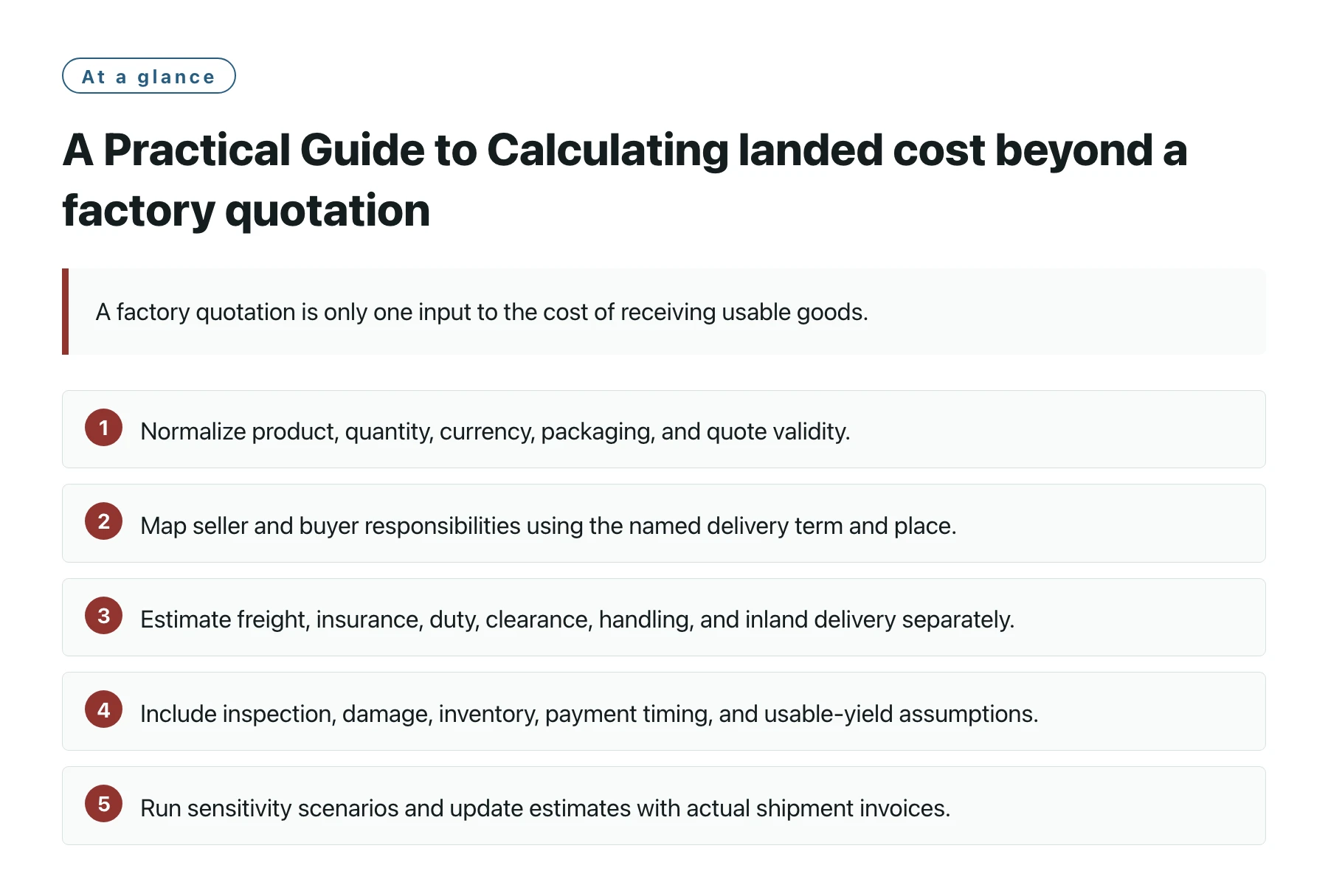
Key takeaways
- Normalize product, quantity, currency, packaging, and quote validity.
- Map seller and buyer responsibilities using the named delivery term and place.
- Estimate freight, insurance, duty, clearance, handling, and inland delivery separately.
- Include inspection, damage, inventory, payment timing, and usable-yield assumptions.
- Run sensitivity scenarios and update estimates with actual shipment invoices.
Landed cost is a decision model, not a universal percentage added to the factory price. Define the destination and shipment assumptions before comparing offers.
1. Normalize what the factory quote includes
Record product specification, revision, quantity, unit of measure, currency, minimum order, tooling, sample charges, packaging, labeling, and quote expiry. Confirm whether prices are per piece, set, carton, pallet, or another unit, and whether the quoted quantity matches the purchase plan.
Ask what is excluded: export packing, inland pickup, export clearance, freight, insurance, destination handling, duties, taxes, inspection, or local delivery. Do not infer inclusions from a short quote label. Keep supplier-specific options visible rather than silently folding them into one unit price.
2. Fix the delivery basis and named place
State the agreed Incoterms® rule, version, and precise named place in the purchase documentation. The delivery term affects which party arranges specified transport tasks, bears certain costs, and carries risk at the defined point. It is not enough to write a port or acronym without confirming the contractual wording.
ICC explains the Incoterms® rules and their allocation of delivery tasks, costs, and risks. Use the chosen rule to map cost responsibility, then model other contractual charges and import obligations separately. Ask a qualified trade adviser if the transaction or route raises a specific legal or customs question. [1]
3. Build the origin-side cost stack
Add export packaging, palletization, factory-to-port transport, export declaration or handling fees, consolidation, terminal charges, and any origin inspection or documentation service that the buyer pays. Confirm whether a quote covers these items or whether they appear on a forwarder invoice.
Use shipment-specific dimensions, gross weight, carton count, and loading plan. Freight can be priced by weight, volume, container, or service type. Keep the rate basis, route, validity, surcharges, and estimated departure date with the model so a change can be traced.
4. Estimate international transport and insurance
Compare modes using the same cargo volume, service level, origin, destination, and date window. Separate base freight from fuel, peak-season, security, documentation, and other applicable surcharges. Record whether quoted transit time is port-to-port or door-to-door and which activities sit outside the estimate.
If cargo insurance is purchased, record who arranges it, the insured value basis, coverage, deductible, exclusions, and policy period. Do not assume that a freight quote includes insurance or that the commercial delivery term supplies the coverage the buyer expects.
5. Model duties, taxes, and clearance carefully
Estimate import duty and other government charges using the destination jurisdiction, product classification, customs value basis, origin, and current rules. Ask a licensed customs broker or qualified adviser to validate assumptions when classification or valuation is uncertain. Keep taxes that may be recoverable separate from nonrecoverable landed cost.
Record brokerage, entry preparation, examination, port storage, demurrage, detention, and release fees where relevant. These costs can depend on documents, timing, inspections, and local practice. A model should show uncertainty rather than presenting an unverified rate as a guaranteed charge.
6. Add destination handling and delivery
Include terminal handling, deconsolidation, container drayage, warehouse receiving, unloading, appointment, liftgate, residential or remote-area surcharge, and final-mile transport as applicable. Confirm who books each service and where responsibility transfers.
Check delivery constraints such as dock availability, pallet dimensions, weight limits, operating hours, and storage capacity. A low port cost is not useful if the receiving site cannot accept the shipment or if extra handling is needed to make goods ready for production or sale.
7. Account for inspection, yield, and inventory
Add supplier audits, pre-shipment inspection, laboratory tests, rework, sorting, or replacement logistics when relevant. Estimate cost per accepted unit, not only cost per ordered unit, if expected defect, damage, or unusable yield is material. Label such assumptions as estimates and update them with actual performance data.
Inventory has cash, storage, insurance, and obsolescence costs. Consider deposit and balance timing, production lead time, transit time, buffer stock, and payment terms. A cheaper early bulk order may tie up working capital longer than a split shipment or later replenishment.
8. Calculate comparable totals and scenarios
Use a consistent calculation structure: product and packaging, origin charges, international transport, insurance, duties and nonrecoverable taxes, clearance and destination handling, local delivery, inspection and quality costs, inventory financing, and expected loss or yield adjustment. Divide by the comparable usable quantity to derive an indicative unit cost.
Show low, base, and high cases for volatile freight, exchange rate, duty uncertainty, storage, or delays. Keep the unit and currency explicit. Distinguish quoted values, broker estimates, historical actuals, and buyer assumptions so reviewers know what needs confirmation.
9. Compare offers and refresh after shipment
Compare suppliers only after aligning specification, order quantity, packaging, shipment mode, delivery point, and service scope. A quotation that excludes a cost is not automatically cheaper. Ask the supplier and forwarder to resolve major gaps before approval and record who owns each cost line.
Buyers consulting JS Sourcing can use a shared landed-cost worksheet to keep quotes and logistics assumptions aligned. After delivery, replace estimates with invoices, customs statements, actual transit time, damage, and warehouse charges. The actual-to-estimate review improves the next purchasing decision.
Sources
Frequently asked questions
Is landed cost simply the factory price plus freight?
No. Include all applicable origin, transport, customs, destination, quality, inventory, and delivery costs.
Should recoverable tax be included in landed cost?
Show it separately from nonrecoverable cost and confirm recoverability with a qualified tax or customs adviser.
Which delivery term should the model use?
Use the exact agreed Incoterms® rule, version, and named place, then map remaining charges separately.
How often should estimates be updated?
Refresh them when quotes, route, shipment timing, classification, exchange rates, or destination charges change.