Scenting Home Care Products: What Formulators Get Wrong First
A scent that performs beautifully in alcohol will often collapse in a detergent, discolour in a candle or fade inside a week in a reed diffuser. The reason is rarely the perfume itself; it is the interaction between the fragrance and the base it has been poured into. Formulators who treat fragrance as a drop-in ingredient spend their time reformulating. Those who test the pairing early spend their time on the shelf.
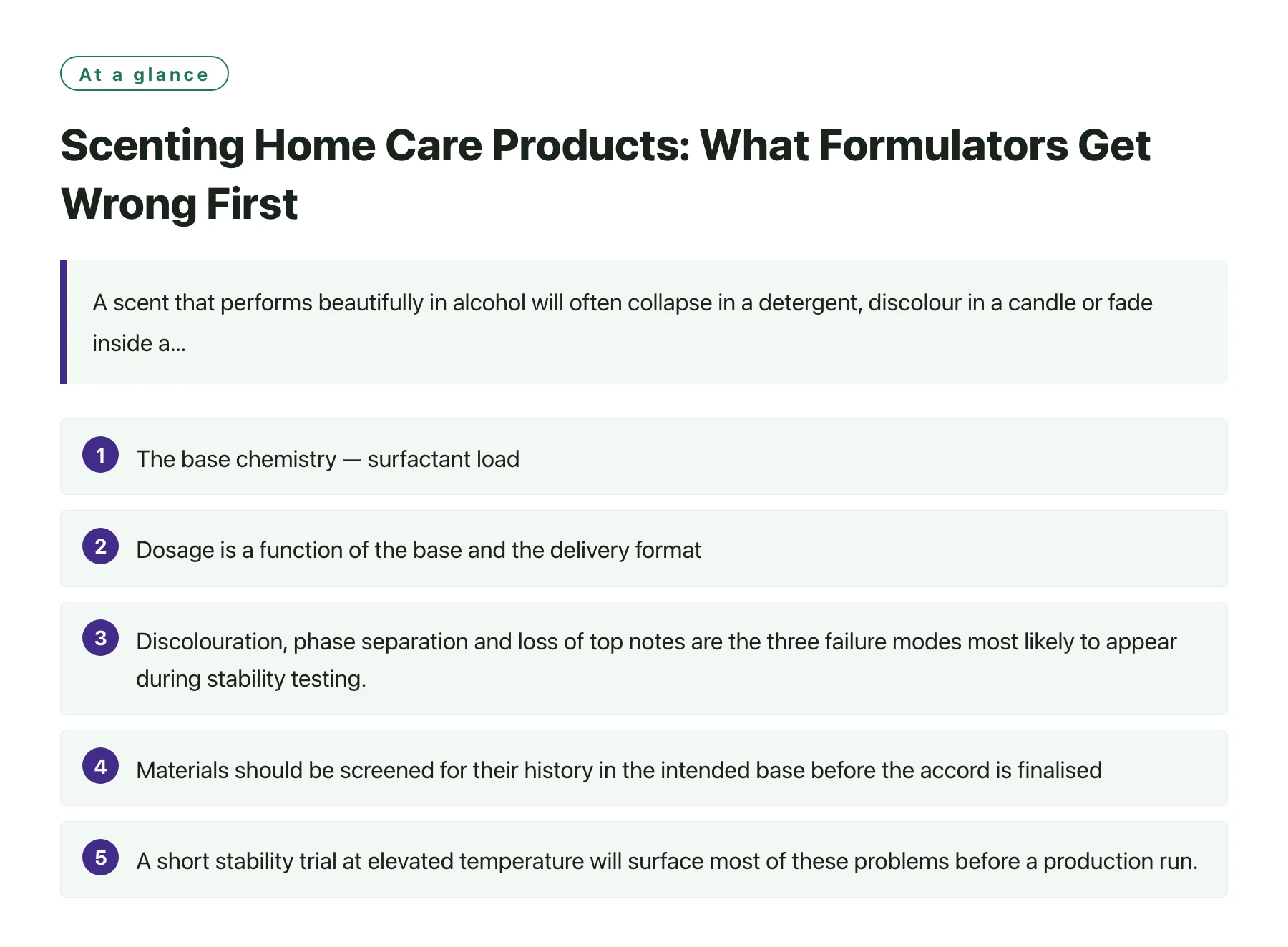
Key takeawaysThe base chemistry — surfactant load, pH, water content, solvent — changes how a fragrance material behaves and how long it survives. · Dosage is a function of the base and the delivery format, not a single recommended percentage that applies everywhere. · Discolouration, phase separation and loss of top notes are the three failure modes most likely to appear during stability testing. · Materials should be screened for their history in the intended base before the accord is finalised, not afterwards. · A short stability trial at elevated temperature will surface most of these problems before a production run.
Home care is where fragrance formulators learn humility. The same accord that reads clean and bright from a blotter can turn dull in a laundry detergent, separate in a hard-surface cleaner, or burn off in the first hour of a candle.
Each of these failures traces back to a specific interaction between aroma materials and the product base. None of them is mysterious once the mechanism is understood, and all of them are cheaper to fix before tooling and artwork exist.
This article walks through the formats, the levers available to a formulator, and the tests that reliably surface problems early.
A screening sequence for a new home care scent
- Define the base before the accordSurfactant type, pH range, water activity and solvent system all constrain which materials will survive, so the base specification comes first.
- Screen materials for base historyReference databases record how materials are commonly used and described, which helps narrow candidates before any blending begins [1].
- Build a simple skeleton firstTest a stripped-back version of the direction in the real base before polishing the accord. Complexity hides the cause of a failure.
- Run an accelerated stability checkHold samples at elevated temperature and inspect colour, clarity and odour at intervals to compress weeks of shelf life into days.
- Check the restricted material headroomConfirm the intended dosage leaves room under the applicable use limits for the product category, so a later reformulation is not forced [2].
- Confirm the packaging interaction lastOnce the base and fragrance pair is stable, check that the chosen container and closure do not introduce a fresh set of problems.
Why the base changes the scent
A fragrance is a mixture of materials with different solubilities, volatilities and reactivities. A base is a chemical environment. When the two meet, the environment usually wins.
That is why two products carrying the same accord at the same percentage can smell nothing alike, and why a formula cannot simply be transferred from one format to another.
Solubility decides what you can smell
In an aqueous base, only the fraction of fragrance that partitions into the air contributes to the scent. Materials that stay dissolved in the water phase are effectively silent until the product is diluted or agitated.
This is why some scents bloom when a cleaner is mixed with water and read as flat when smelled from the bottle. It is also a reason to test in the use condition, not just the concentrate.
Reactive bases consume materials
Bleach, peroxide and high-pH systems can attack certain aroma materials, changing both the odour and the colour of the product. Aldehydes and some esters are common casualties in aggressive bases.
Formulators usually respond by choosing materials with a documented history in that environment rather than by increasing the dosage. More of a material that is being consumed simply raises cost without restoring the scent.
Volatility sets the timeline
In an open system such as a reed diffuser, the fragrance is continuously evaporating, so the lightest materials leave first and the residue is whatever remains. Candle wax adds a second constraint, since the fragrance must be released at the temperature of the melt pool rather than at room temperature.
Both cases reward accords built with a considered ratio between top and base materials rather than a heavy top-note load.
Four home care formats and their dominant constraint
| Format | Main constraint on the scent | Formulation lever | What fails first in testing |
|---|---|---|---|
| Candle | Fragrance must release at melt pool temperature and disperse evenly through the wax | Wax type, pour temperature and fragrance load all interact | Poor throw, tunnelling, or fragrance sweating from the surface |
| Reed diffuser | Continuous evaporation with no heat, and the carrier must wick reliably | Solvent choice and the ratio of volatile to base materials | Top notes fading within days and a flat residual odour |
| Surface cleaner | Surfactant system and pH can mask or react with aroma materials | Material selection for the pH range rather than dosage increases | Discolouration or a sharp chemical shift after a few weeks |
| Laundry detergent | Fragrance must deposit on fabric and survive the wash and rinse | Encapsulation or deposition technology alongside the accord itself | Scent that performs in the bottle but not on dried fabric |
| Room spray | Volatile carrier and immediate impact, with no base to hold the scent | Ratio of top to base notes and the choice of solvent | Strong opening followed by a rapid and complete disappearance |
The fourth column is the one to plan around. Each format has a characteristic failure, and knowing it in advance turns stability testing from a search into a confirmation.
Dosage thinking for people who dislike rules of thumb
Recommended dosage ranges are a useful starting point and a poor finishing point. They describe what is typical, not what is right for a given base, market and cost target.
Start from the required effect, not the number
Ask what the consumer should experience and when: a burst on opening a bottle, a lingering trace on fabric, or a steady background in a room. Each of those is achieved by a different balance of materials, and only then by a dosage.
Testing at two or three dosage levels in the real base usually settles the question faster than debating percentages on paper.
Cost scales with dosage, effect does not
Fragrance is often one of the more expensive inputs per kilogram in a home care product. Doubling the dosage rarely doubles the perceived intensity, because the base and the packaging cap the effect.
A better use of the budget is often to improve the accord's structure — a stronger base note or a more effective carrier system — than to raise the load.
Work with a supplier who knows the category
Fine fragrance and home care place different demands on the same material. A supplier experienced in both can flag a candidate that will discolour in a cleaner or fail to throw in a candle before it reaches the stability trial.
The category breakdown on the Xuelei official site is a useful example of how one manufacturer separates fine fragrance, home fragrance and scented body products, which is the kind of split to look for when you ask who will develop the accord. Independent formulation literature is a further check, and technical journals in the field routinely cover base interactions and test methods [3].
The most common expensive mistake in home care scenting is testing the fragrance in the wrong medium. An accord approved on a blotter or in ethanol has not been tested at all for a candle, a diffuser or a detergent. Insist on a sample in the real base, at the real dosage, in the real container, and give it at least a week at elevated temperature before you approve it. That single change prevents most reformulation cycles.
Sources
- The Good Scents Company —— A reference database of aroma materials with odour descriptions, CAS numbers and typical usage information.
- IFRA: Safe Use and Fragrance Science —— IFRA's explanation of how fragrance materials are scientifically assessed for safe use and how those conclusions are applied by the industry.
- Cosmetics & Toiletries —— A technical magazine for cosmetic formulators, covering ingredients, formulation science and testing methods.
Frequently asked questions
Can I use the same fragrance oil in candles and diffusers?
Not usually without adjustment. Candles release scent at melt pool temperature and need materials that perform when warm, while diffusers rely on continuous evaporation at room temperature. The two formats favour different balances of volatile and base materials.
Why does my home fragrance lose its top notes so quickly?
Top notes are the most volatile part of the accord and leave an open system first. In diffusers especially, the citrus and fresh materials disappear within days and what remains is the base. Building a stronger mid and base structure is usually more effective than adding more top notes.
How do I stop a scented cleaner from changing colour?
Discolouration is usually a reaction between specific aroma materials and the base or the packaging. The fix is material substitution rather than dosage reduction. Screen candidates for compatibility with your pH range and surfactant system, then confirm with an accelerated stability trial.
Is a higher fragrance load always better in home care?
No. Beyond a certain point the base cannot hold or deliver more scent, and the extra material is either wasted or causes problems such as sweating in candles or instability in emulsions. The useful ceiling is set by the base, not by the label.
How long should a stability test run before approval?
Long enough to see colour, clarity and odour behaviour at elevated temperature over several weeks of equivalent shelf life. A practical approach is to hold samples warm and inspect at intervals, then confirm the final candidate in the intended packaging.