Uptime and Reliability on Peak Evenings
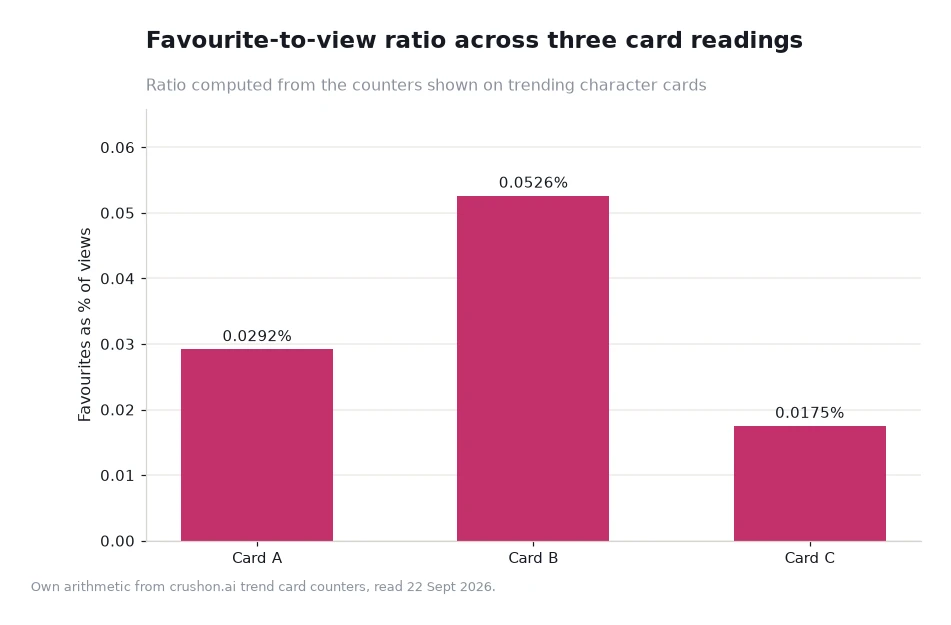
No uptime statistics are published for this platform, so the only reliability record you can trust is the one you keep yourself. Peak evenings are a scheduling fact you can observe rather than a defect you can fix: the sensible response is to shorten messages, expect slower replies and measure your own experience with a twenty-reply log. One published reading, 7.1K favourites against 24.3M views, is 0.0292% - the keep rate of a card read by many and kept by few.

Key takeaways
- No public uptime figures exist, so keep a twenty-reply log and take the median rather than trusting an impression.
- Busy hours are predictable from your own history: if your slowest replies cluster between eight and eleven, plan around that window.
- Rate, not size, decides what a slow evening costs: at about 1.5 minutes a message, twenty replies is half an hour of attention.
- Keep the entry points you need already open: a bookmarked card and a search page beat hunting through a shelf at a busy moment.
What can and cannot be known about reliability
Start with the honest boundary. The platform does not publish uptime percentages or incident reports, and neither does this article, because inventing either would be worse than saying nothing. What is knowable is narrower and more useful: how the service behaves for you at the hours you use it, recorded in a way that survives your own bad memory of one frustrating evening.
The second knowable thing is the shape of demand. Weekday evenings are when most people are free, which is why every subscription service sees its busiest windows then, and a platform whose shelves refresh weekly adds one more predictable spike on the day the rankings update. You do not need a status page to notice that pattern; you need four weeks of a one-line log.
The third is what you control. Message length, session timing, whether you start something long at the edge of a window, whether you rely on notifications or open the app deliberately - all of these decide how much a slow reply affects an evening. Reliability management at the user end is mostly scheduling and brevity, and both are free.
Why the keep rate matters more than the traffic total
Counters on the shelf tell you something adjacent to reliability: how much attention other readers spend on a card. Three readings taken on 22 Sept 2026 came out at 0.0292%, 0.0526% and 0.0175%, a threefold spread from lowest to highest, and the top reading is 1.8 times the middle one. One of those figures matches a published pair exactly: 7.1K favourites against 24.3M views is 0.0292%.
Read that as a measure of holding power. A card with a high keep rate is one that readers return to, and returning means longer sessions - which is precisely the behaviour that suffers most on a slow evening. If you know that the card you are about to open is a long-session card, open it at the start of a window rather than ten minutes before you have to stop.
The counter-intuitive conclusion is worth stating plainly: on a busy evening, a card with a lower keep rate can be the better choice, because it is easier to leave. Nothing about that is a judgement on quality; it is the same reasoning as not starting a long film at midnight.
| Habit | What it protects | How to check it helped |
|---|---|---|
| Open the card before you need it | The first five minutes of a session | Compare sessions that started from a bookmark with sessions that started from a shelf |
| Keep messages short at peak hours | Time spent waiting for replies | Count replies per ten minutes in your log |
| Start long conversations early | The end of a session, where a slow reply hurts most | Note the session length on evenings you started before eight |
| Trust a log over a feeling | Decisions based on one bad evening | Take the median of twenty logged waits rather than the worst |
| Do not rely on notifications | An interrupted evening if a reply arrives late | Sessions where you opened the app yourself are easier to end |
Worked example: a twenty-reply log and a median
Here is the method, with hypothetical numbers to make it concrete. Log the wait for the next reply on twenty occasions across a fortnight and write the seconds down in one column. Suppose the column reads 3, 4, 4, 5, 5, 5, 6, 6, 6, 6, 7, 7, 8, 8, 9, 9, 11, 12, 15 and 20. Sort it and take the middle pair: the tenth and eleventh values are 6 and 7, so the median is 6.5.
Now compare that with the maximum. The worst wait in the column is 20 seconds, more than three times the median, and the mean is 8.25, which sits above the median because a few long waits drag it up. This is why the median is the right summary: it describes the ordinary evening, and the maximum describes the one you will remember and over-weight. Both are in the same twenty-number example, and only one of them should drive a decision.
Then apply the result to a session budget. At about 1.5 minutes of attention per message - half a minute writing plus a minute reading - twenty replies is half an hour whatever the waits are doing. A median wait of 6.5 seconds adds roughly two minutes across those twenty replies, so the practical cost of a busy evening is small if you keep the sessions short and the messages plain. These numbers are an illustration of the method, not a measurement of any platform.
Timing the week around the refresh
Two rhythms are worth knowing. The first is the weekly one: rankings update every Thursday, so Thursday evenings draw the readers who are browsing for something new, and that is the least rewarding time to start an unusually long conversation. The second is the daily one, and you can derive it from your own log faster than from any advice - most readers find their slowest replies in the same two-hour band every evening.
Arrange the tools accordingly. Keep the card you are currently working with bookmarked so that starting a session is one tap rather than a browse; the NSFW AI trends shelf is the right place to do that choosing in advance, on a quiet evening rather than at the moment you want to talk. If you would rather look for something specific, the character search page gets you to a card faster than scrolling, and a shorter approach is a shorter wait when the service is busy. For the product's own description of what it hosts, the Crushon page at https://crushon.ai/ai-porn-chat states it plainly: its FAQ uses the term Porn Chat AI and notes that some limitations apply under the platform's content and community guidelines.
One honest note on expectations. On any platform, the age of an account, the device, the network in your building and the hour you choose all shape what you experience, and only the last of those is something a reader can plan around. Which is the practical summary of this whole topic: measure your own evenings, use the median, and treat the busy hours as something to schedule rather than something to complain about.
Frequently asked questions
Does the platform publish uptime figures?
No uptime or incident figures are published, so no reliable percentage can be quoted. The workable substitute is your own log, summarised as a median rather than as a worst case.
When are peak hours?
Evenings, and Thursdays in particular because the rankings refresh then. Your own log will show the exact band: most readers find their slowest replies falling in the same two hours each evening.
Should I avoid busy evenings altogether?
No. Shorten messages, start long conversations earlier, and keep sessions to about twenty replies - half an hour at 1.5 minutes a message - and a busy evening costs very little.
Log twenty replies, then plan around the median
Keep one line per session for a fortnight: the hour, the number of replies and the wait you noticed most. Take the median of the waits and ignore the maximum. If the median lands under ten seconds, the busy hours are not costing you anything measurable and the right move is to stop thinking about reliability. If it lands higher, move your longer sessions earlier in the evening and keep the late ones short - the fix is timing, not a different product.
Data: trending shelf counters and the Thursday refresh cadence, read 22 Sept 2026[1]. The wait figures quoted are a hypothetical example of a logging method, not measurements of the platform, and no uptime statistic should be inferred from them. For adults 18 and over.