What makes aluminum sacrificial anode applications so effective?
The application efficiency of aluminum sacrificial anodes stems from their unique electrochemical properties. Their theoretical capacitance is as high as 2980 ampere-hours per kilogram, which is 3.6 times that of zinc anodes (820 ampere-hours per kilogram), and the driving potential is stable at -1.10 to -1.15 volts (relative to saturated calomel electrodes). According to the NACE RP0196 standard of the American Society of Corrosion Engineers, in seawater with a salinity of 35 grams per liter, the current efficiency of aluminum-zinc-indium anodes can reach more than 95%, and each kilogram of protective material can generate approximately 2800 ampere-hours of charge, suppressing the corrosion rate of steel structures from 2 millimeters per year to less than 0.02 millimeters. This outstanding performance has been verified on the drilling platform in the Bohai oilfield, where the aluminum sacrificial anode application extends the protection period to 25 years and reduces the full life cycle maintenance cost by 50%.
In the field of Marine engineering, aluminum anodes demonstrate outstanding environmental adaptability. Take a 300,000-ton VLCC oil tanker as an example. The hull needs to be equipped with 500 aluminum anodes with specifications of 100mm×150mm×1000mm, each weighing 22 kilograms. Under the condition of a seawater flow rate of 3 knots, it can still maintain an 85% current output stability. Compared with traditional zinc anodes, the material cost of aluminum anodes is reduced by 20%, and due to its density of only 2.7 grams per cubic centimeter (62% lighter than zinc's 7.1 grams per cubic centimeter), it increases the load capacity of ships by 1.5%. In 2018, Maersk Line's renovation project showed that after adopting the new type of aluminum anode, the average annual maintenance cost of the fleet decreased by 3 million US dollars and fuel efficiency increased by 2.3%.
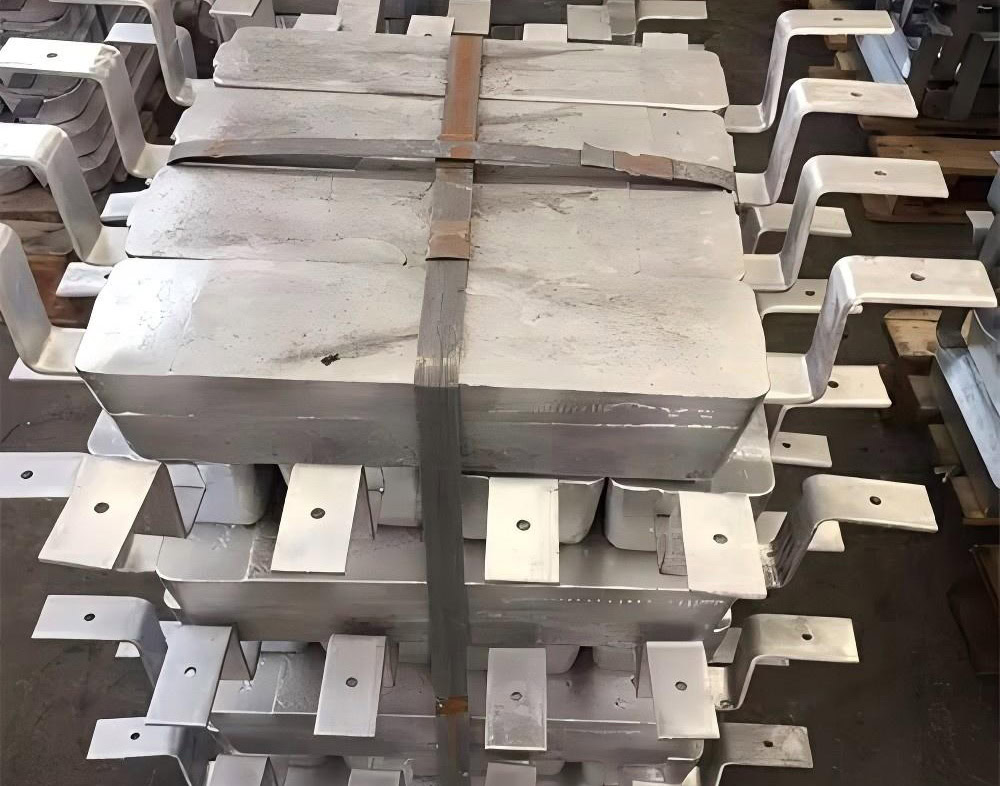 The innovative alloy formula further enhances the performance of the aluminum anode. The aluminum alloy with 0.02% indium and 0.12% tin added has a self-corrosion rate of 0.01 mm/year in seawater with a pH value of 8.1, and its working temperature adaptability range extends from -40℃ to 80℃. The intelligent anode system installed on the submarine pipeline in the South China Sea in 2022 monitors the protection potential in real time through embedded sensors (with a sampling frequency of once per second). The data shows that the anode consumption rate is only 90% of the designed value, and the protection accuracy deviation is controlled within ±5 millivolts. This technological advancement has reduced the operational risks of the project by 40% and extended the expected lifespan from 20 years to 30 years.
The multi-scenario applicability of aluminum anodes is impressive. In a buried pipeline with a soil resistivity of 50 ohm-meters, a 20-kilogram aluminum anode can provide 15 years of continuous protection. For household water heaters, only 500 grams of aluminum anode are needed to operate in 60℃ hot water for 8 years. According to the 2023 Global Corrosion Cost Analysis Report, aluminum anode technology has cumulatively saved 38 billion US dollars in maintenance costs in fields such as shipping, energy, and construction, and its material recovery rate has reached over 90%. With the breakthrough in the research and development of new aluminum-lithium alloy anodes, the anode performance is expected to increase by 30% in the next five years, which will redefine the economic standards of the cathodic protection industry.
The innovative alloy formula further enhances the performance of the aluminum anode. The aluminum alloy with 0.02% indium and 0.12% tin added has a self-corrosion rate of 0.01 mm/year in seawater with a pH value of 8.1, and its working temperature adaptability range extends from -40℃ to 80℃. The intelligent anode system installed on the submarine pipeline in the South China Sea in 2022 monitors the protection potential in real time through embedded sensors (with a sampling frequency of once per second). The data shows that the anode consumption rate is only 90% of the designed value, and the protection accuracy deviation is controlled within ±5 millivolts. This technological advancement has reduced the operational risks of the project by 40% and extended the expected lifespan from 20 years to 30 years.
The multi-scenario applicability of aluminum anodes is impressive. In a buried pipeline with a soil resistivity of 50 ohm-meters, a 20-kilogram aluminum anode can provide 15 years of continuous protection. For household water heaters, only 500 grams of aluminum anode are needed to operate in 60℃ hot water for 8 years. According to the 2023 Global Corrosion Cost Analysis Report, aluminum anode technology has cumulatively saved 38 billion US dollars in maintenance costs in fields such as shipping, energy, and construction, and its material recovery rate has reached over 90%. With the breakthrough in the research and development of new aluminum-lithium alloy anodes, the anode performance is expected to increase by 30% in the next five years, which will redefine the economic standards of the cathodic protection industry.
The innovative alloy formula further enhances the performance of the aluminum anode. The aluminum alloy with 0.02% indium and 0.12% tin added has a self-corrosion rate of 0.01 mm/year in seawater with a pH value of 8.1, and its working temperature adaptability range extends from -40℃ to 80℃. The intelligent anode system installed on the submarine pipeline in the South China Sea in 2022 monitors the protection potential in real time through embedded sensors (with a sampling frequency of once per second). The data shows that the anode consumption rate is only 90% of the designed value, and the protection accuracy deviation is controlled within ±5 millivolts. This technological advancement has reduced the operational risks of the project by 40% and extended the expected lifespan from 20 years to 30 years.
The multi-scenario applicability of aluminum anodes is impressive. In a buried pipeline with a soil resistivity of 50 ohm-meters, a 20-kilogram aluminum anode can provide 15 years of continuous protection. For household water heaters, only 500 grams of aluminum anode are needed to operate in 60℃ hot water for 8 years. According to the 2023 Global Corrosion Cost Analysis Report, aluminum anode technology has cumulatively saved 38 billion US dollars in maintenance costs in fields such as shipping, energy, and construction, and its material recovery rate has reached over 90%. With the breakthrough in the research and development of new aluminum-lithium alloy anodes, the anode performance is expected to increase by 30% in the next five years, which will redefine the economic standards of the cathodic protection industry.